
|
DECK IMPROVEMENTS
Under Construction -
Last Updated: 7 Jan 08
Future Additions:
Cleats
Stern and Bow Rails
Jacklines
Mast Safety Rails
Stern Storage Box
Anchor Roller Tray
Awnings
Hatch Security Bars
Arch
/ Radar / Solar Panels
Dave designed and had
fabricated this aluminum goal post arch upon which to mount solar panels,
radar, wind instruments, anchor and stern navigation lights and dinghy davits.
Originally
the 2" main support posts port and starboard extended above the solar panels
and held a Windbugger wind generator and the Furuno radar dome. These shaded the solar panels
throughout most of the day so that the panel output was severely degraded.
This is the case with anything of any size mounted above solar panels so
they were remove shortly after returning to the US.
A new aluminum pole was added across the top of the arch and the panels
remounted so that they could be
rotated fore and aft about 45 degrees each way. Doing so
allows the panels to generate approximately 30 percent more amp hours
per day.
Another 25 percent was added by wiring the system
for 48 volts and upgrading the regulator to the
Outbacker solar regulator with the latest MPPT technology. See
additional info on the Furuno radar dome mount under the Electronics
section.
Dinghy and Davits
The
10.5’ Alliance RIB dinghy is pushed out gently while being raised and rests
above the wind-vane at stern rail level when fully stowed.
This places it well out of reach of anyone attempting to steal the
motor from a small boat at night. For
open ocean passages it is stowed upside down on the cabin top forward of the
mast for security and so that the Monitor wind vane can be used.
We use triple blocks top and bottom for the falls so that the dingy
is easier to raise and lower. It can easily be strapped in
tightly to prevent chafe when underway.
We carry two outboard motors, a 5 HP and a 15 HP
of the same brand (Nissan/Tohatsu) so that they can use the same fuel tank. One backs up
the other in case of a failure. The 15 provides planing speed for those
long range exploring or diving expeditions while the 5 uses far less
gas for closer dinghy trips while at an anchorage for an extended time.
(top)
Swim
Platform
This custom swim
platform is approximately 12” above static waterline, and designed
to handle big seas. The platform decking was originally made
of approximately 55”X20” of
3/4” white Starboard. We now use only the starboard half as we
rarely go to the port side of the platform. The decking lays on a
permanently mounted 1-1/2” diameter bent and welded aluminum pipe
frame
that can be used by itself for boarding in an emergency. The decking is easily
removed and stowed below by removing 4 bolts. Whenever it is rough enough to stow the dinghy on the
forward deck we remove the platform decking.
(Topica Post 04/18/2005)
The issues for us in designing a stern swim platform were:
-
Allowing room for a
Monitor wind vane to be installed
trailing just behind the platform (approx 20" off the stern).
-
Ensuring we could
lift the dinghy out of the water
to a high enough
stowed position so that it would be secure from theft and we could use
the swim platform while at anchor. When we are using the Monitor for long trips the dinghy is mounted strapped down tight
forward of the mast on the cabin top.
-
Allowing partial
disassembly by quickly removing the Starboard
decking and leaving the frame intact for long passages when we might encounter a
gale or worse. This
configuration still allows use of the framework for
recovery
of a man or other objects that fall overboard.
-
Providing a platform
for swimming, diving, showering, boarding the
dinghy, a water level fish gaffing position, and a standing position for
the fish cleaning station on the Monitor mounting struts.
Overall we think our $400
expenditure on our swim platform was one of
the best projects we've done to Soggy Paws. (top)
Anchor Locker and Windlass

This is the forward chain/rode locker showing the new
athwart ships
divider for chain stowage aft and line/chain stowage forward. This
was a Tom Service (s/v Jean Marie, 44WO) idea slightly modified for our purposes. The new
glassed in 3/4” plywood divider is 14” forward of the aft locker
bulkhead and the top edge is 13” below the overhead. Also shown is
the new 1/2” aft half bulkhead which holds the chain off the locker
door as it piles up. At the top of the locker can be seen the aft
end of the curved aluminum chain pipe used to direct the fall of the
chain 6” aft of the windlass hawsehole. A new line/chain hawsehole
was cut just forward of the Lofrans Tigress windlass base.
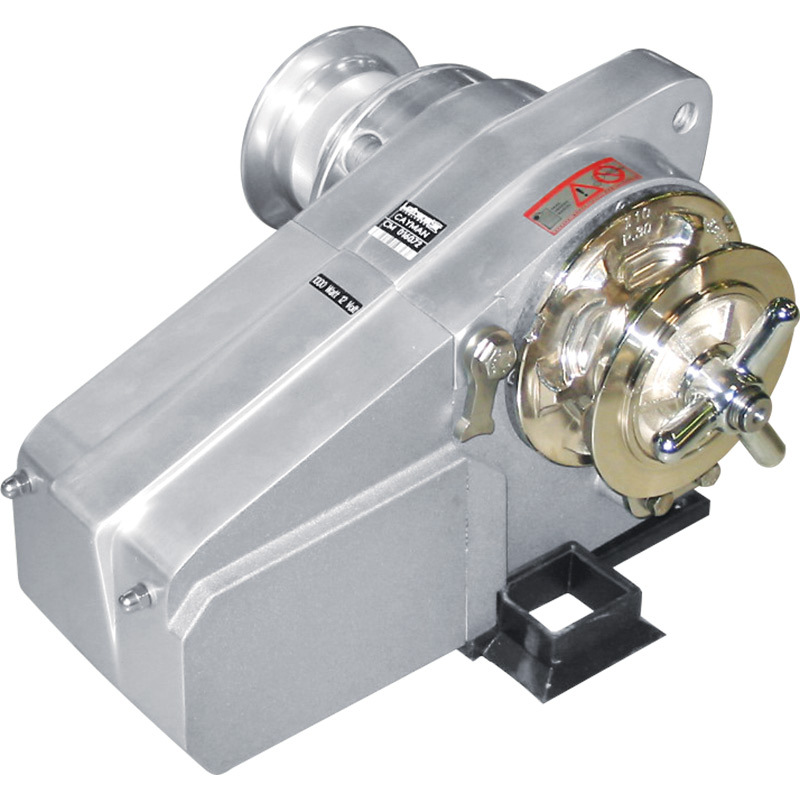
(Topica Post 12/28/07) I once had a Simpson Lawrence Sea Tiger 555 manual
windlass but changed it out when the shaft broke for a Lofrans Tigres. We
have been very happy with it for 8 years now. It is a big step in
convenience and safety to move from an all manual windlass to one with both
electric and manual. I have used the manual feature on my Tigres and
although slow it works well. Others have installed the larger, stronger,
heavier and more expensive Lofrans Falcon with equal success. And there are
several other brands that come highly recommended. Get a spare brush set for
which ever windlass you chose.
I installed my Tigres on a custom made fiberglass mounting block that sits
the windlass about 2 inches off the deck. With that height you can still use
reasonable length bolts, get almost 90 degrees turn of the chain around the
chain gypsy and still not have a huge lever arm as you would with a mount
high off the deck. Going up 8 or 9 inches just to get exactly 90% turn on
the gypsy is not what you want to do. I used no caulk but EPDM rubber
gaskets between the deck and mount and mount and windlass. So far no leaks.
While you are mounting the new windlass consider rearranging your anchor
chain locker so that the chain weight is as far aft as possible and the
spare rode is forward. A description of our setup is on the website. Ron
Sheridan, of Memory Rose, has a unique arrangement with the chain and
windlass coming down the starboard side of the boat.
Also while you are at it, pay some attention to your anchor roller tray and
any improvements you might want to make to it, like beefing up the roller
pins, providing rollers where necessary to keep the chain from chafing
against it, and changing to an aluminum grooved roller for your chain. An
easy solution to getting at the nuts under the roller tray (and those for
the forward chain plate) is to cut a rectangular hole in the vertical deck
section just behind the tray large enough so you can get a wrench on them.
Then seal a plate over the hole with screws and an appropriate gasket when
you are finished. Obviously, whatever you do make sure all is absolutely
water tight and as strong as possible with no significant weak links.

Lofrans Tigres 1200 Watt windlass
on custom
fiberglass mount |

Chain locker aft, spare rode forward,
the first 100' of chain is led aft through
a PVC pipe and stored in the bilge
just in front on the mast |

Anchor roller tray removed, access
hole open in vertical deck |

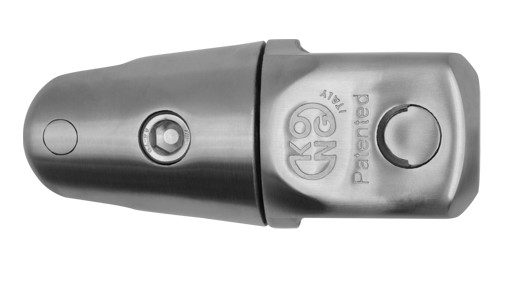
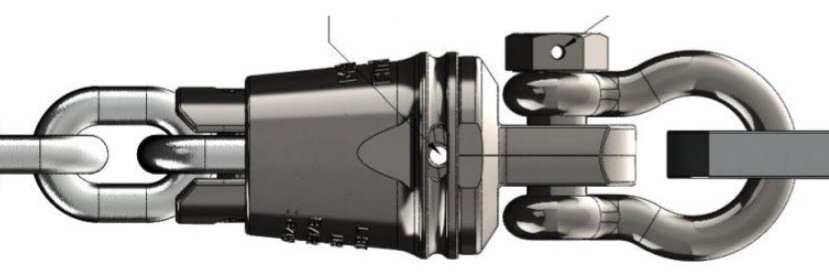
INOX Kong SS swivel, 6000 lb working
load exceeds HT chain SWL, shackles
match chain 5200 lb SWL |

Anchor roller tray with 5/8" roller
pins and shortened by about 10" |

Bow ground tackle rigged for
Hurricane Wilma |
We now carry 300’ of 3/8 HT chain (200' in the aft bin and 100'
stretched aft under the V berth to a floor locker just forward of
the mast), and 300’ of 3/4” 3
strand nylon line with 45’ of 3/8” HT chain in the forward bin.
We also carry considerable additional chain and
line rodes in other lockers mainly under the floor.
The windlass solenoids and remote up/down hand control are mounted
high up on the port side aft bulkhead with the remote coming out the
forward hatch for use on the fore deck. Mounted outside on the stem
9” above the waterline and stoutly backed inside is a new 1/2”
Winchard high strength bow eye used as a no chafe snubber attachment
point. (top)
Ground Tackle
I have owned my CSY 44 for 10 years now.
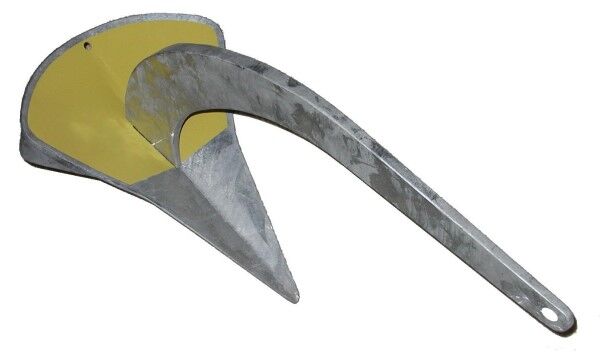
The boat came out of charter with a 45 lb CQR, a Fortress 37, two 12'
lengths of SS chain and about 200' on 3/4" nylon in two sections. I
soon dumped the undersized CQR and replaced it with a Bruce 66. Two
years later I replaced the Bruce 66 because of its ability to pick up
boulders in its flukes and difficulty setting in grass and soft mud. I started out with a Delta 55
anchor for our trip around the Carribbean and later added a Delta 88.
We now have 5 anchors onboard for our circumnavigation: Delta 88, Delta 55,
Fortress 55, Fortress 37 and a Danforth 35 HT. I started with 3/8" SL (short link high tensile) chain. Since the chain has a working strength of about 5200
lbs, I use two shackles of the same strength between the chain and anchor: a
High Tensile 7/16" (the largest that will fit through the chain standard end
link) and a regular 5/8" into the anchor.
If you use BBB 3/8" chain, it's
working strength is only 2900 lbs, so lesser shackles could do. If you do
have a weak link, it should be at the anchor/chain connection so that if you
do break your ground tackle you will only lose the anchor and not the rest.
Obviously it should not be much weaker.
We use a Lofrans Tigres windlass strongly
bolted through a 2" fiberglas mounting pad to the deck. For snubbers I
have an assortment of all 5/8" lengths of 3 strand nylon in lengths of
10-35'. They can be fastened to the boat through closed chocks or over
the bow rollers to any of six heavy bow cleats. Another option I like
is to attach a snubber to a heavily reinforced stem padeye near the water
line.
I don't think that having a swivel
will help those that are having a problem with their anchors dislodging
in changing winds. I think that would be more a problem with the anchor type
vs. the bottom and/or the setting technique.
From the start, I was in the habit of end-for-ending and remarking the chain
about every year and a half when I was at a dock. I had the chain re-galvanized once in 2002 to help extend it's service life. Between late
1998 and 2002 we often anchored for two weeks or more in one place while
cruising in the Caribbean. Since then while doing charters in the Fla Keys I
never anchor more than a night or two in one place. I finally replaced
this anchor chain in 2006, in preparation for our circumnavigation.
I used to have no swivel in the ground tackle and this worked fine, except
that occasionally I would have to back out most of my 200' of chain to
unravel the twists. This was reduced somewhat when I had a chain groove cut
into the aluminum anchor roller on the bow. Even so it took some
considerable attention and time to minimize the twists in the chain as it
came up after anchoring. Then about a year and a half ago I noticed the
chain starting to twist up again while on charter and before I had time to
undo the twists I had a problem.
As the wind picked up one night at anchor I
went forward to let out a little more chain and the twists jammed in the
chain pipe below the windlass. I realized then that if this had been a
really serious situation and I had had to let out more chain or dump it to
save the boat I would have been in trouble. Since the chain was near the end
of it's service life I replaced it a few months later with 300' of new 3/8"
HT ACCO chain at $2.50 a foot. It took us over a half hour to get all the
twists out of the old chain as it came out of the chain locker and up
through the chain pipe. Part of the new chain is now led aft through a large
PVC pipe in order to reduce the weight in the bow.
Many quality swivels and shackles you could buy are only rated for the BBB
chain, and if used with HT chain become a very weak link. That problem,
severe corrosion, improper rigging and lack of mousing were problems with
many of the boats that have reportedly lost their anchors due to problems
with swivels or shackles.
Asian chain, swivels and shackles have a
reputation for flawed construction and are always suspect in my mind.
Typical are those that are not marked with a working load (SWL). Many
swivels used in moorings are always underwater and never inspected until
they corrode through. Take a close look sometime walking down the docks in a
marina at the number of severely corroded, improperly rigged or unmoused
shackles used in ground tackle on seldom cruised boats. The large
professionally engineered and annually inspected mooring field in Boot Key
Harbor does use a large swivel in their design. The design is rated for 50'
boats in a Cat 2 hurricane. It is obviously most important to properly size
and maintain any swivels or shackles used in ground tackle.
I had resigned myself to put up with the chain twist until a very
experienced friend with a similar boat and ground tackle came across what
looked to be a proper swivel. The engineered swivels we bought about a year
ago through West Marine (special order) are made in Italy by a very old
company making nautical fittings. It is very high quality, 316 SS, tested
and patented. It comes in 3 sizes and mine has a working strength of 6600
lbs and a breaking strength of 21000 lbs. On the instruction sheet is
printed "KONG, Bonoiti, since 1830, INOX AISI 316 Swivel Anchor Connector".
Cost was about $130. I still use the same two shackles to make the
connection between chain, swivel and anchor.
Hopefully it will help reduce the twisting of my chain in the future.
Cap Rail
Replacement
After 8 years of living
with the original CSY 44 teak cap rails and their various problems I finally
decided to do something about it. I looked carefully at all the replacement
options including teak, oak, Douglas fir, various plastic/wood mixes,
fiberglass and aluminum edge extrusions. Both Jim Dill of Chilly Pepper and
I reached the same conclusion and ordered the only aluminum extrusion in
existence that will fit--a heavy duty extrusion built by Taco Metals in
Miami. Three 34' sections were enough to do both boats. We both had
previously replaced our chain plates, mine external, Jim's internal. We also
had each redesigned and replaced our lifeline stanchions. Here for any of
you interested in a month's worth of work on your 44 CSY are the steps
involved in the process of removing and replacing the cap rails with an
aluminum extrusion.
-
Remove all lifeline
stanchions and other fittings on the cap rail.
-
Sand the somewhat
evenly spaced screw bungs so you can locate them all
-
Remove the bungs with
your favorite technique. I turned Stacy loose on them with an hammer and
narrow chisel.
-
Clean out the screw
heads with a sharp pick and remove the screws with a screw gun
-
Remove the teak caps.
Again I turned Stacy loose on them with two flat pry bars and a sledge
hammer. They were off in a day. It was easy to see why they had
leaked given the sorry caulking job.
-
Scrape and rough sand
the fiberglass caps to remove the remaining 5200. We had 5200 only on
the inboard edges of the caps and around most of the screw holes.
-
Clean out all the
holes with an oversized drill bit. Use a countersink bit to bevel the
tops of all the holes and remove any high spots around them
-
Epoxy patch all the
holes and damaged areas caused by the demolition team, including the
trim piece screw holes in the hull just under the cap
-
Tighten as many
remaining screws/bolts as you can to get the heads below the level of
the cap
-
Sand the cap and trim
piece screw holes as smooth as possible with 100 grit and a random orbit
sander.
-
Clean the cap with
denatured alcohol and apply blue tape along the inboard corner of the
cap and around the curved portion of the steps just below any sanded
portion
-
Apply two coats of
epoxy and at least 1 layer of 4" wide fiberglass cloth well wetted out
over the top of the cap taking care to keep it very even along the
inside edge just at the corner
-
When dry sand as
smooth as possible with 100 grit so there is no cloth print through
-
Remove the blue tape
-
Lightly drill dimple
the cap where the stanchion bases will fit
-
Clean the cap with
denatured alcohol
-
Apply blue tape just
below/outside any sanded areas along the inside corner of the cap and
around the curved section at the steps
-
Apply 5 coats of
Awlgrip primer with a roller to the cap, apply several coats to the trim
piece screw holes with a small brush. The top coat will be applied
after all the extrusion installation work is done.
-
After several days
drying remove the blue tape
-
Sand all primer as
smooth as possible with 100 grit including the raised tape edge of
primer at the inside corner of the cap and around the steps
-
Measure twice and cut
the extrusion to fit your caprail. With external chainplates I had to
cut my extrusions into two pieces with the joint at the cap shroud
chainplate and then notch them on the outside for the chainplates. Jim
did his in one piece on each side and notched them on the inside for the
chainplates. All the cutting and notching was done with a grinder and
cutoff wheel.
-
Grind the extrusion
cutouts and ends with a grinder and then file smooth
-
Rough sand or grind
any protruding edge of the deck flange so it won't interfere with the
extrusion fit
-
Dry fit the extrusion
to the cap starting at the aft end. Fit 1/4"X2" oval phillips screws
after carefully clamping the extrusion tight against the outside of the
cap and drilling holes with a 3/16" drill bit. Use vaseline or other
lubricant on the screw threads to reduce the chance of breaking one off.
-
Carefully unscrew and
remove the extrusion
-
Clean the extrusion,
cap and screw heads of vaseline and fiberglass dust
-
Bevel the tops of the
screw holes so the caulk will form an O ring seal
-
Remove any old caulk
along the outside edge of the cap with a knife so new caulk will grab
-
Vacuum the cap, all
screw holes and the outside edge of the cap
-
Alcohol clean the
upper hull side, cap and rail where caulk has to grab
-
Dry fit the rail
again with screws only every 5 holes and apply blue tape to the top of
the cap and hull where they meet the extrusion
-
Remove the extrusion
and ensure the tape is on tightly
-
Apply your favorite
caulk to the cap and all screw holes. I used 5200.
-
Apply Tefgel to the
bevel on all screw heads
-
Clamp and screw the
rail to the cap using a helper to hold the forward end up off the caulk
until you are ready to screw that section down. Work on 5' sections at a
time.
-
Remove excess caulk
with a narrow scraper
-
Wipe any remaining
caulk off the extrusion with Lacquer Thinner
-
Apply caulk at ends
and chainplates and fair smooth
-
Remove the tape
within about 6 hours and clean up any remaining caulk
-
Remove all dust and
clean the inside 3 inches of cap with alcohol
-
Apply blue tape just
below the sanded inboard corner of the cap, around the curved cap at the
steps and along the inboard and hull edges of the extrusion
-
Apply three coats of
Awlgrip topcoat to the cap between the tape strips and at the trim piece
screw holes
-
Remove the tape when
the paint is dry and lightly sand the edges if necessary
-
Reinstall the
lifeline stanchions using good caulking technique and 1/4" spacers (I
used Starboard) under the bases if they overlap the extrusion.
Sand the spacers as necessary to ensure the bases stand straight
upright.
-
Install all other
hardware ensuring a tight and waterproof fit
|


|
And that's all there is
to it!
Total cost about one boat unit, $1K. Major benefits include a watertight cap rail, a bullet proof outboard edge, a strong attachment point for such
things as roller reefing blocks, fenders, and running rigging and best of
all no more varnishing. As painting and fiberglass work are not among my
strong suits, many thanks to Ron of Memory Rose for advising/supervising and
helping me with this project. Without his help it wouldn't have gotten done.
I also had the advantage of watching Jim Dill of Chilly Pepper do his first.
(top)
Lifelines
& Stanchions
I have few pics of my aft toe rails and lifeline stanchions. You can see the Schaefer model of two piece
lifeline stanchions in the West Marine catalog under lifeline
stanchions. Mine are Hayn, British I believe, 30" tall and purchased in
Trinidad in 2000 for about $40 per set. They have four holes in the base
plate for 1/4" bolts. When bolted down they are rock solid and have
not leaked a drop. There are many others
available. Try looking them up on the internet.
Here's something else to think about. I read an interesting article not
long ago explaining how a 200 lb person thrown against reasonably tight
lifelines will produce about 4000 lbs tension at the ends where they
connect to the bow and stern rails. If that is true, it is no place for
rusty plastic coated 3/16" lifelines, 25 year old 304 SS turnbuckles and
jury-rigged railing connections.
I just installed new lifelines
consisting of 316 SS 1/4" 7X19 bare wire with Nicropress fittings and
thimbles on the ends. I'm going to use multiple turns of small spectra
line to tension them, high tensile shackles and beefed up tangs on the
rails in order to try to keep the strength up. Hopefully this will be
enough to keep us lightweights aboard.
Toe
Rail Finish
(Topica post 02/09/2005) Dag,
I think you are on a better track using the painted finish. As a matter of
fact Jim Dill of Chilly Pepper recently did his aft teak toe rails with a
Napa two part polyurethane very similar to Awlgrip in a teak color that
looks super.
While in Trinidad I used
a cheap locally mixed two part polyurethane by Sikkens on my cap and toe
rails that has been on 5 years, although it is now somewhat sun bleached
on the top. It is still intact but has not been touched in 5 years. Based on
Jim's recommendation, and he knows paint, I will repaint my exterior wood
soon using the Napa product. We don't do varnishes on Soggy Paws,
except on the cockpit teak where we use Cetol touched up every couple of
years. We hate to varnish! (top)
Jan 2008 Update. Just finished
having a local painter, Arnulfo Juares, here on the Rio Dulce paint our eyebrows and aft toe rails using
the same Napa two part MSD urethane enamel that Jim Dill had had custom
mixed. It is a deep brown, just a little more brown than the light teak
cockpit combing. While we were at it, we removed the jib sheet lead
block tracks to rebed them as they were leaking badly. After a good
sanding, Arnulfo cleaned the areas to be painted and touched up any bare
wood with two coats of epoxy. Then he applied two coats of the paint
one right after the other. Now that it is dry, it is hard as a rock
and hopefully will last a long time. It sure looks good!

Aft toe rail with Trinidad brown
paint,
6 years old |

Fwd port cap rail with Trinidad
paint |

Arnulfo Juares applying first coat
of Napa brown
MSD paint |

Fwd port cap rail with two coats of
Napa paint just applied |

Bow cap rails with Napa paint |

Port eyebrow with Napa paint |

Port aft toe rail with Napa paint |

Comparison of port toe rail with Napa
brown paint and teak cockpit combing
with Cetol |
| |
|
Amidships
Closed Chock
It is easy to rebed the
mid ships closed chock. Just remove the two bronze end pieces by removing the
4 self-tapping screws that hold each piece to the bulwark and gently pry
them off. Inside is a fiberglass tube that can be removed and then rebedded.
When I did mine several
years ago the tubes were actually too long and did not allow the end pieces
to seal against the bulwark properly. You may have the same problem. If so
just grind the ends to shorten it up so it fits properly. Use plenty of
caulk carefully placed when you rebed them. Mine are now chromed and in good
and tight. (top)
Stern Line Reel
This line reel is made of
two plastic ends from a West Marine spool of line, a PVC inner tube
about 20" long, some
1/4" allthread and nuts to hold it all together. It holds 500' of 5/8"
polyester double braided line.
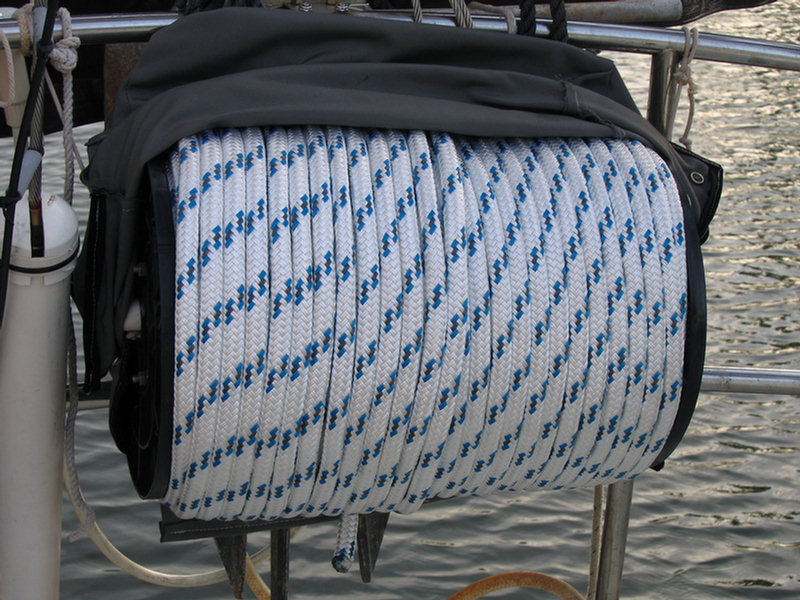
The line can be used for many things
including running out a kedge anchor, towing a drogue, tying a long line to shore and as a messenger for a heavier
towing line. The reel mounts ready for action but out of the way on the
stern rail. It has a Sunbrella cover to protect it from the sun. |

 |
Main Cabin Windows
The new main cabin windows were constructed and installed
in 2004. The goal was to solve the storm window storage and last
minute installation problems by having permanently installed bullet proof
windows of sufficient strength to withstand storm wave conditions from the
beam. The windows are constructed of 1/2" Polycarbonate/Lexan on the
outside and 3/8" on the inside, sandwiching the cabin sides all around with
a 2" overlap. They are through bolted using 1/4" SS pan head bolts
through the anodized 1/4"X2" aluminum frame, the outer Lexan, the
cabin side, the inner Lexan and finally the original inner fiberglass frame.
I used straws to isolate the SS bolts from the aluminum frame, surgical
tubing to allow for expansion around the bolts as they passed through the
Lexan and nylon washers to isolate the bolt heads and nuts from the frames.
The outer seal is provided by the use of 2"X1/4" EPDM rubber flat gasket
material between the outer Lexan and the cabin side. Finally a piece
of Textlene covers each window to provide some degree of shade and privacy.
See Dashew's Cruising Encyclopedia for more details on this method of
installation. An alternate method used by Tackless Two uses a strong
adhesive product called C 10. See their website in the future for more
details.

Finished windows in place with Textlene
covers. |

Exterior view showing the frame, bolts
and dark tint to the Lexan |

One of the frames from the inside showing
the bolt sticking through
|

Inside during installation before the
inner frames are installed |

Two of the MR10 pieces cut to size with
a saber saw and over sized holes drilled |

Cups with installation hardware ready
to be installed |

Interior view showing the inside original
frame which was reinstalled with nylon
washers |
|
(top) |